
| 
jan.jpg
Why?

Over the past two years, Dexia, Bayer Materials Science, Securex, Eandis, Monnikenheide, Euroclear, Barclays, Coda and Rockwell International and several other internationally recognized companies entrusted Jan De Visch with high impact and strategically important initiatives ranging from organization effectiveness and design to senior leadership talent assessment and.development. Engagements are bespoke and fundamentally grounded in a partnership of trust, therefore, client volume is typically limited to under twenty firms with assignment spans of three months to five years. This model ensures that clients experience Connect & Transform as flexible, responsive, and high touch; and that clients are presented with cutting edge ideas, practical solutions and cost effective interventions. It also enabled Connect & Transform to indirectly and positively affect the career progress and work contribution of the more than 40,000 staff members of these leading organizations.
Based on tracked performance data and quantitative analysis findings, Connect & Transform is known for its unique ability to support organizations in their transformation to a business that dynamically generates the core capabilities it needs to be innovative and achieve breakthrough performance.  By increasing the quality of decision making at all Work Levels and by calibrating and aligning the company’s strategy, culture, structure, and (talent) systems to the needs of its customer and varied stakeholder interests, Connect & Transform helps organizations optimize market place dynamics and realize their full value and vision.

 
How?

"Nurturing trust within individuals, teams and organizations" 

Connect & Transform's contribution is professional, pro-active, pragmatic, and always results-oriented. Through dialectical inquiry and an appreciative approach, our dialogue with staff, managers and directors  considers and reveals the unique needs and capacities of leaders and / or their teams. Connect & Transform’s consultants are senior level professionals with deep and diverse experience.  Their insight and perspective helps to determine the most effective method to optimize the firm’s own talent and capabilities to achieve organizational objectives.
Connect & Transform’s interventions are based on the following key value-creation principles:

Read more...
 
For whom?
Connect & Transform reaches leading multinational and multicultural organisations in the private and public sector  that have questions about the efficient alignment of strategy, structure, processes and people.
The following have put their trust in Connect & Transform: Securex, Alcatel-Lucent, Bayer Materials Science, Tessenderlo Chemie, Johnsons Control, Muhka, Athlon Car Lease, Euroclear, Mobistar, Eandis, Nissan, Flemish Government (Ago), TüVRheinland, Gybels SA/NV, Tinfoz Nizzi (Luxemburg) and Mobistar.
Read more...
 
By whom?

Connect & Transform has been founded in 1998. Jan De Visch has more than 25 years of experience managing change processes and general HR functions. He sees the limits of the current HR approaches and has developed, together with international networks, value creating alternatives.

Read more...
 
Partners

Jan closely works together with three international networks. He is founding partner of CETAN (Cutting Edge Transformation Advisors Network), Associate Researcher of the Interdevelopmental Institute and Associate Partner of MVC International.

Read more...
 
For you as a private individual?
Ask Connect & Transform

Name:
Email:
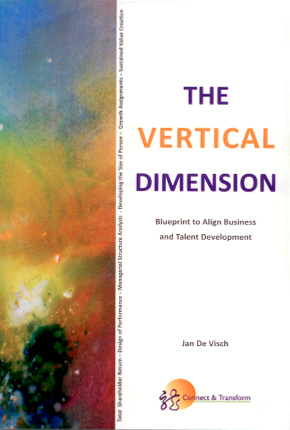
The Vertical Dimension. Blueprint to Align Business and Organizational Development.

cover-the-vertical-dimensio.jpg


Authored by Jan De Visch, this insightful book is about organizational development and puts forward a leading-edge theory on the critical thinking and essential processes that lead to organizational success. The book’s focus is on companies that aim to provide consistently superior returns for stakeholders—in other words, organizations that have a mandate to create stakeholder value. Jan De Visch brilliantly takes what is essentially an “integral” perspective. He critiques current and widely accepted approaches to talent management that exist within firms as an isolated discipline, separate and distinct, from other organizational systems. In essence, he advocates an integrated approach that clearly aligns business strategy, organizational structure, and the development and leverage of human and knowledge capital.

Read more...
 
News & Activities
Professional Course
Professional Course in Talent Management & Career Development

The English edition of this course will start on February 26th 2009. Until now, 167 professionals have followed the program to achieve greater effectiveness in their talent and career development approach. The program offers practical help models, practical consultancy frameworks, validated tools, effective process introductions and a broadening of one’s own coaching approach. The course is based on practical cases, of which some are presented by participants at their learning assignments. The learning process is deepened through simulations, practical exercises, application of the tools offered , dialogue and group discussion. In the course of  the program, participants are entitled to two individual 1-hour coaching sessions.


Read more...
 
Inspiration Post

Register for the Connect & Transform inspiration post to receive update information on how to build success through people, purpose, structure and processes.


References
Zoek gericht
Communication
Employee Engagement
High Potential Coaching
HR Transformation
Managerial Leadership
Organisational Development
Performance Management
Project Excellence
Role Analysis
Strategy, Structure & Process
Talent Identification
Talent Management
Tools
Source Material
The Vertical Dimension
cover-vertical-dimension-10.gifBlueprint to Align Business and Talent Development by Jan De Visch (2010)
 
Managing Corporate Lifecycles
cover-managing-corporate-li.gifManaging Corporate Lifecycles by Adizes (2004)
 
Retooling HR
cover-retooling-hr-100.gifUsing Proven Business Tools to Make Better Decisions About Talent  by John Boudreau (2010)
 
Connect & Transform

Koningin Astridlaan 144
2800 Mechelen
Belgium
Phone: + 32 (0)478 31 24 24
Behavioral Pathways : Integrating the Cognitive Dimension in Competency Based Assessment Approaches Print E-mail
introducingcognitive.jpgAs I reflect on my regular interactions with Senior Managers it is clear to me that something is wrong in our approach to competency management in business today. Building on the insight that the critical factor in business success is not only what people do, but also how their thinking processes influence their actions, I explore a way to re-design competency frameworks, which enables a higher predictive validity in assessing potential and may even lead to the design of more effective developmental programs.

Many organizations invest heavily in various assessment models to provide objective assessment of the qualities of their staff.  These assessments are usually based on efforts to identify the key competencies required for success within that business environment. Often there is a dual goal: diagnostic on the one hand , serving as a basis for identifying both individual needs to improve performance, take on a larger role and/or ensuring alignment between the qualities of the person and the requirements of the role. The other goal is more developmentally focused, with the assessment data being used to identify and prioritize training and development initiatives. These systematic efforts enable the organization to clarify what it is looking for and enables them to focus on key development areas and at the same time allows individuals to receive concrete feedback about their strengths and weaknesses.  The results form the basis of personal developmental plans.

It struck me, when asking Heads of Human Resources and Senior Managers about their experiences and results of personal development plans,  that there is significant concern about the effectiveness of this approach. One HR-Director even told me that as little as 8 % of the Personal Development Plans are ever carried out. Moreover, developmental programs, based on the results of such assessments, do not produce the expected outcomes . And even when there is significant investment  in validating data presented by line managers, there is no guarantee of achieving a qualitatively better talent pool. These observations led me to explore the limits of competency-based approaches.

It is fair to say that the focus and added value of classical behavioral/personality assessments is on identifying weaknesses (the necessary behaviors that are ‘not yet there’). However, as I mention above,  and as is pointed out by Elliot Jaques (2002), Roger Martin (2007) and Otto Laske (2008), the critical factor in business success is not only what people do, but also how their cognitive processes produced their actions. In addressing business problems it is the thinking pattern of the person in charge of that action that influences the kind of contribution he/she will make and the implicit use of his/her competences.

Following on the work of Elliot Jacques, Otto Laske (2008) introduced the concept of ‘thought forms’ as a way to look at cognitive processing ability, or fluidity of our thinking processes. Based upon the insights of Laske, a cognitive coaching approach was developed, distinguishable from behavioral coaching.  Although a lot of writings on behavioral coaching provide extensive recipes for what must be done to function at a certain level (cfr. the critical transitions as specified in “The Leadership Pipeline”), the basic argument of the cognitive coaching school was that no one addressed the question of what mindset was needed to make the suggestions work. Moreover, most competence frameworks are static and do not acknowledge that the mere definition of a competence takes on different forms, according to the level of complexity in which it is used. On the other hand, the cognitive approach does not define  a direct link between the mindset and  behavioral development.

Otto Laske (2008) recently provided a developmental framework that enables us to diagnose fluidity in our cognitive processes. He explored how people distinguish between four basic thought- form categories that indicate both how we think AND linking these thought forms with the level of complexity a person is contributing on. Thought forms can be considered as the deeper cognitive structure that allows one to make sense out of reality (Otto Laske, 2008).
There are four different perspectives:
• Things emerging or in motion (Process)
• Things making up a ‘big picture’ (Context)
• Things sharing common ground (Relationship)
• Things viewed as systems in transformation, that is, mutually intertwined and dependent upon each other.


The basic premise is that first, things have to exist (C). They can then be seen as undergoing change (P) and being related to each other (R). Transformational systems (T ) ‘pre-suppose’ this sequence: C, P, R.
- ("Context") The first category builds upon the conviction that there is always a bigger perspective in which you can position your own point of view. All problems are layered and the trick in increasing effectiveness is to start building common ground from that broader perspective. The thought forms in this category help distinguishing what kind of elements/variables one sees.
- ("Emerging change") There is always an ongoing change process, often not made explicit or emerging. It helps if you integrate the 'emerging' perspective in your arguments. Often problems are just analyzed from a context perspective, forgetting to position the issue in a time dimension of ongoing changes. By making this dimension clear, it often helps to recalibrate the relative importance of different perspectives. The thought forms here enable the active listener to identify what a  person sees as constant change.
- ("Common Ground" - Relations). These thought forms enable us to identify the kind of relationships a person is seeing and creating. On a higher management level this means for example that there is always a common ground in seemingly conflicting points of view. Finding this common ground often requires a different kind of 'modeling' (Roger Martin, 2007).
- (Systems in Transformation). There is always a systemic viewpoint. Connecting changing contexts with ongoing processes and redefining relationships often leads to transformational thinking. The different thought forms in this group allow us to specify the degree of open vs. closed systems thinking. On a senior management level for example this  means that most solutions to strategic problems can only be realized by looking at changing the borders of the system in which the problem raised. So redefining the system almost always helps in increasing impact.

So when a manager sees the world as being in constant transformation, he is aware that each context has its big picture, and is eager to understand here-to-fore hidden relationships, he will be operating from a different stance, and this stance enables him to use cognitive tools of a new kind. 

It is my impression, working with the cognitive interviewing framework of Elliot Jaques and Otto Laske, that thought forms occur at certain levels of complexity. For example ‘recognizing that two or more systems are related to each other, and can be coordinated, occurs when someone functions successfully on a complexity level where redefining systems and processes is crucial. I examined the relationship between the levels of complexity and the thought forms occurring at each level. This work resulted in the description of seven ‘Mental Highways’. The ‘Mental Highways’ can be seen as thinking patterns or language structure schemata through which meaning making at each of the capability levels (according to Elliot Jaques) is created. I’m convinced that these Mental Highways allow us to revisit the way most competence frameworks are built.

Most competence frameworks have four weaknesses :
(1) The defined behaviors differentiate on the first two to three levels of work complexity, and not higher.
(2) Building proficiency in a certain competence follows a path starting from a junior position towards mastership, which is often translated as being able to pass the competence to another person. This assumes that the definition of a competency remains the same on the different levels of complexity. This is not correct.
(3) It is clear that competencies defined in equal categories (eg. “level 3” in a clients competency-scheme) are not defined at the same “Mental Highway” level if you were to look at them from a cognitive perspective.
(4) It is not clear how one can develop a certain competency. The relationship between the ‘classical competency level ‘and the kind of developmental tasks is based upon a belief that a growth task will work, but not on science-based modeling. A lot of growth assignments are not carried out because the ‘size of the person’ (‘thinking capabilities’) is still too small for the ‘size of the role’.
These points make it understandable why the derived behavioral assessments have limited predicted power for Senior Management and/or CEO-functioning.

An alternative is to redesign the behavioral competence models, based upon the idea that thinking precedes behavior and using the Mental Highways as a model to identify the changes in behavior at higher complexity levels.
Let me share two examples, summarized in the table below. The vertical ax is one in increasing complexity (from the ‘lowest’ level 1 at the bottom to the level 5 at the top). Horizontally I have selected two ‘classical’ competency dimensions, ‘Thinking strategically’ and ‘Supporting productive working relationships’.  The new behaviors that are introduced are shown in bold, the increased complexity (and correlated use of thought forms) is show in italics.

 
Level of complexity (cfr. Elliot Jaques, 2002) Thinks strategically Supports productive working relationships
5. Transformational. Creating new business models. Understands the organisation’s current and potential future role within the business environment.  Considers multiple perspectives when assessing the ramifications of a wide range of issues and develops solutions with long term viability. Considers emerging trends, identifies long-term opportunities and balances organizational requirements with desired wholes of outcomes. Builds and sustains positive relationships within the organization and across companies to transform signals of change in the value systems of major stakeholders into new generic products and services.. Looks for shared agendas and capitalizes on the positive benefits that can be gained from diversity and harnesses different viewpoints..
4. Breakthrough New Product, New Service/ New Market Understands the organisation’s objectives and links between the business units, organization and the different external stakeholders agendas.  Considers multiple perspectives when assessing the ramifications of a wide range of issues. Anticipates priorities and develops long-term plans that address both current and future requirements. Seeks to align business unit activities with strategic priorities. Builds and sustains positive relationships within the organization and across companies with a diverse range of external stakeholders. Anticipates and is responsive to changes in market/technology solutions. Looks for shared agendas and uses these to bring people together to develop a different perspective that enables breakthrough developments.
3 : Systemic New Process and or Value Stream (re-thinking) Understands the organisation’s objectives and contributes to the development of plans, strategies and team goals. Identifies broader influences and considers the ramifications of issues and longer term impact  on the team’s and cross team’s  work objectives. Builds and sustains positive relationships with a network of key people internally and externally. Anticipates and is responsive to changes in client needs and expectations. Recognises shared agendas and works toward mutually mutual beneficial outcomes.
2 : Situational Quality and continuous Improvement  (Optimizing) Understands the work environment and contributes to the development of work plans and team goals. Demonstrates an awareness of the implications of issues and problems that may impact on own and team’s work objectives. Builds and sustains positive relationships with team members and clients. Is responsive to changes in client needs and expectations. Proactively offers assistance for mutual beneficial relationships.
1 : Procedural Executional and or Service Excellence Understands the work environment and participates in team goal setting. Demonstrates an awareness of issues that may impact on designated work tasks. Builds and sustains positive relationships with team members and clients. Actively participates in teamwork and activities. Responds under direction to client needs and expectations.
 One can do this exercise for most of the competencies.This redesign is highly versatile for individuals and particularly useful in guiding leadership development for :
- Those who aspiring to leadership positions at all levels
- Those transitioning to the next level, or to a new role
- Those who want to be more effective at their current level
The validity of assessment procedures and the effectiveness of developmental efforts will be enhanced by pointing very clearly to the interwoveness of behavior, thinking tools and the complexity level one is expected to contribute at.  Mastering the thinking tools (thought forms) will also enable managers  to discover that an other’s point of view, while seemingly in opposition to their own, is a fruitful antithesis to their own point of view, and can be used as a launching path of synthesizing opposing views.
Your feedback is most welcome.
Write comment
Name:
Email:
 
Title:
Please input the anti-spam code that you can read in the image.

3.23 Copyright (C) 2007 Alain Georgette / Copyright (C) 2006 Frantisek Hliva. All rights reserved."


Design Vera | Fueled by Spoox.be